Long before digital marketing, simulation software, and instant calculations became popular. British engineers were solving some of the most complex problems ever faced by modern industry. Nowhere was this more evident than in aviation. Designing aircraft capable of flying further, faster, and more safely relied not on algorithms, but on intellect, experience, patience, and rigorous testing.
Early British aviation engineers worked in an environment where mistakes were costly and success was uncertain. Calculations were performed by hand, often repeatedly, using slide rules, logarithmic tables, and meticulous handwritten notes. Structural loads, aerodynamic forces, and engine performance had to be estimated with remarkable accuracy, knowing that an error on paper could translate into disaster in the air.
Engineering decisions were shaped by observation and experimentation. Wind tunnels became essential tools, allowing engineers to test scale models and refine designs through careful measurement. These experiments were slow and labour intensive, but they built an intuitive understanding of airflow and behaviour that no computer could instantly provide. Many engineers developed an almost instinctive sense for how an aircraft would respond before it ever left the ground.
British aircraft design benefited greatly from this deep practical knowledge. Engineers such as those working at de Havilland, Vickers, Handley Page, and Bristol learned by building, flying, and modifying real machines. Prototypes were rarely perfect. Each test flight generated data, not in digital files, but in pilot reports, engineering sketches, and physical inspections of airframes and engines.
Problem solving often required ingenuity rather than calculation alone. When materials failed or performance targets were missed, engineers adapted designs using the resources available. New alloys were tested, structures reinforced, and components redesigned without the luxury of computer aided optimisation. Decisions were guided by experience, collaboration, and sometimes informed intuition.
Perhaps the greatest challenge lay in engine development. Piston engines and later gas turbines involved complex thermodynamics, fluid flow, and mechanical stress. Engineers relied on painstaking bench testing and incremental improvements. Failures were analysed by dismantling engines piece by piece, examining wear patterns, cracks, and distortions to understand what had gone wrong.
Teamwork was another defining feature of this era. Engineering problems were rarely solved in isolation. Designers, draftsmen, test pilots, and workshop staff worked closely together, sharing observations and debating solutions. Feedback loops were human rather than digital, but they were often faster and more insightful because they were grounded in direct experience.
This approach extended beyond aircraft themselves to infrastructure and operations. Airports, maintenance systems, and safety procedures were developed through observation, adaptation, and incremental improvement. Engineers and operators learned from accidents and near misses, steadily improving standards through lessons hard earned.
While modern engineering benefits enormously from computational power, the achievements of this earlier generation remain extraordinary. British engineers built world leading aircraft, pioneered jet travel, and established safety principles that still underpin aviation today. They did so without screens, simulations, or instant answers, relying on discipline, creativity, and courage.
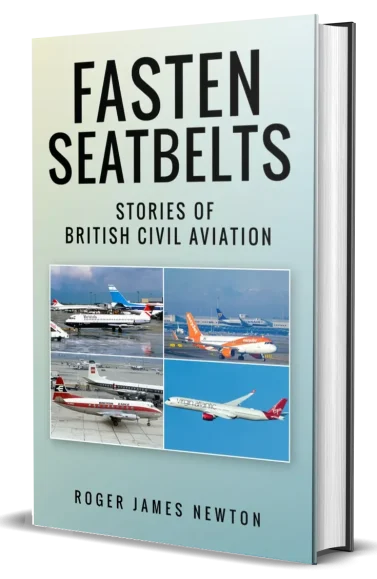
These stories form a central thread within Fasten Seatbelts: Stories of British Civil Aviation by Roger James Newton. The book captures the human ingenuity behind Britain’s aviation achievements, revealing how engineers overcame technical limitations through skill and determination. It brings to life the methods, decisions, and personalities that shaped an industry long before computers transformed engineering practice.
Understanding how these engineers worked offers us the understanding that innovation is not solely driven by technology, but by people willing to think deeply, test relentlessly, and accept responsibility for their decisions. The legacy of Britain’s pre computer engineers continues to fly above us, embedded in every aircraft that takes to the skies today.
If you want to know more about this subject, read Fasten Seatbelts: Stories of British Civil Aviation.
Grab your copies from Amazon: https://www.amazon.com/dp/1969644400.